

Melting Pot
A Way to Change

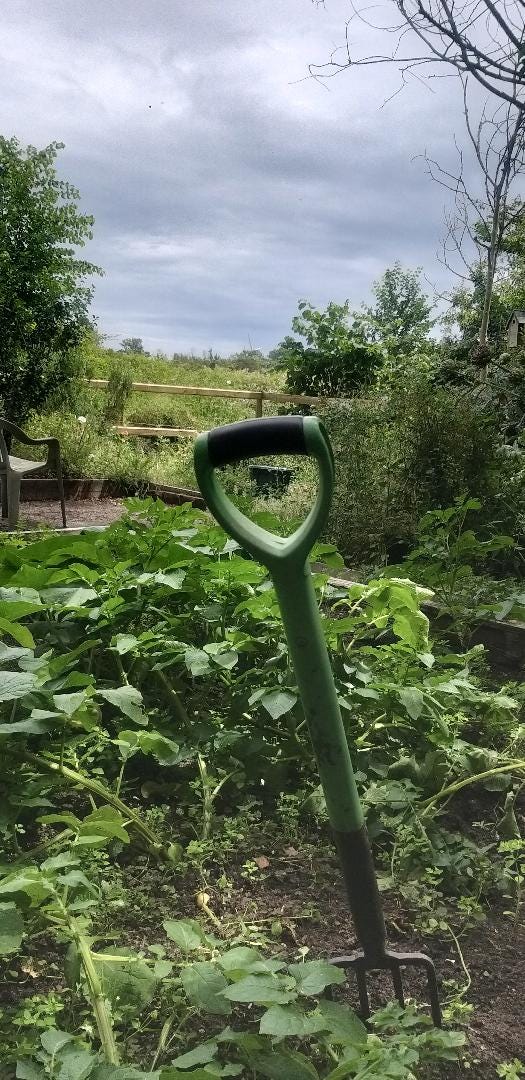
I sometimes think that each season has a theme, whether it’s trees or the river or music and, so far, this summer seems to be dominated by vegetables. Potatoes have cropped up regularly this week. My eccentric friend was wondering whether to scrap her plants, as they are spindly and look unhealthy. Another friend dug up a single plant and was disappointed to only get a few small spuds. She cooked them, but they suddenly went from being hard to being overcooked.
We have been luckier. David also dug up a plant and, although there weren’t that many tubers, there were enough to provide for two meals. Ours were the size of new potatoes and tasted delicious, just like old fashioned ones. If you don’t know what I mean, think about a home-grown tomato from a polytunnel, the skins are thin and the flavour is intense. Now compare that to a supermarket product. They look superb, but the taste doesn’t live up to expectations. Our potatoes gave us that greenhouse effect, perfect.
There was a heatwave last week in the UK. It created some interesting behaviour, which is typical of the British! We have a gardener, who comes in to mow the lawns and strim the wilder parts of the garden. I should mention that he is called John, is the wrong side of fifty and has a generous paunch. Generally, he wears a wife-beater’s vest, but in the heat he took it off and hung it on his van’s wing mirror. David called up the stairs to me and said “John’s taken his shirt off. It’s not a pretty sight”. It reminded me of the 1970’s song The Streak and the line “Don’t look, Ethel”.
The news programmes have been reporting on various incidents caused by the extreme heat and these articles have ended with advice about keeping curtains and windows closed and drinking plenty of fluids. I have been drinking green tea, which I do anyway, a particular brand of lemon iced tea (San Benedetto), which David’s buys on the internet from Italy for me and coconut water. Apparently the latter is very good for people, because it’s not only great for hydration, but contains electrolytes, which the body can lose when it sweats. It’s also considered one of those ‘super foods’ that help combat free radicals in the body. This is all very satisfying, as I like coconut water.
Overall, it seems everything has been altered by the heat, certainly the potatoes and the gardener. The news has also changed both its focus and tone, revolving around the weather, which may be ‘news’ but surely isn’t the dominate event in the world, although this country has a habit of turning weather into drama.
I’ve also altered my behaviour. I had a eureka moment regarding my poetry. I am a minimalist and try to avoid too much adornment, I don’t have any body art (tattoos) and I don’t wear much jewellery, our home isn’t overwhelmed with knick-knacks and my favourite flower arrangements are ikebana. So I’m taking the same approach to what I write. I might record the flow of consciousness as it occurs and enjoy reading every single word, but I’m trying to distill the final version into the essence of a particular thought or observation. I’m not trying to produce classical haiku, which is the ultimate in minimalist verse, but my own striped down style of poetry. I’m hope you will feel it when you read “Slumbering Earth”.
I find the idea exciting and my brain is hopping about with ideas, like popcorn in a saucepan. I have written outlines for three books and intend to revisit the novel I wrote in Australia to see if I can refine it to find the core of the story. I could become too busy to engage with the world, if I’m not mindful. David might comment that I’m halfway there, as I disappear from his view once again.
You may recall that in astrology recently there were lots of predictions around the eclipses and aspects of the planets causing portals to open briefly providing opportunities for transformation. Now, I wonder if I’ve stepped through a portal and become transformed – what a lovely idea.
Since I’ve already mentioned “Slumbering Earth” my poem this week comes from that collection. The book covers many themes, but could be described as a quiet observation of human experience, so it views ordinary things and turning points without being melodramatic. This particular poem is not about vegetables, but change:
RIPPLES
They sat side by side watching the ripples
spread out and then fade
from the place where he had skimmed
a stone across the water.

It was nearly time to leave
not only the lakeside,
but each other,
for different universities.

They had made plans to meet,
definitely at Christmas,
but they both knew
it would be different from now on.

Settling in, studies, new friends
would shape them
through separate experiences,
no longer sharing every day.

It was their bittersweet
threshold.
The ripples
had almost gone.
Your poem does feel like a transformational portal has been crossed Amber, both within your writing and the subject, I enjoyed its parred back yet powerful observation - it was very evocative of the change heralded.